Meta description: Your managed services contract may protect uptime but miss Zendesk license waste. Learn the clauses to add for SaaS cost control.
Your MSP keeps tickets moving, patches servers, and watches alerts. Meanwhile, your Zendesk bill keeps creeping up because former agents still have seats, part-time users sit on the wrong plan, and nobody owns the cleanup.
That’s a managed services contract problem, not just an admin problem.
Most contracts still treat IT like racks, firewalls, and help desk queues. They’re good at defining response times. They’re much worse at defining who tracks SaaS waste, who reports it, and who fixes it before renewal. If your agreement says the provider will “support Zendesk” but says nothing about license audits, usage reviews, or seat cleanup, you’re paying for a blind spot.
Why Your Current Managed Services Contract Is Costing You Money
A lot of teams find out too late that their managed services contract protects operations, not spend.
You sign an agreement for monitoring, endpoint support, identity management, maybe security. The MSP does the work it promised. Uptime is fine. Ticket response is acceptable. But your finance lead still asks why Zendesk costs more this quarter than last quarter when headcount didn’t grow.
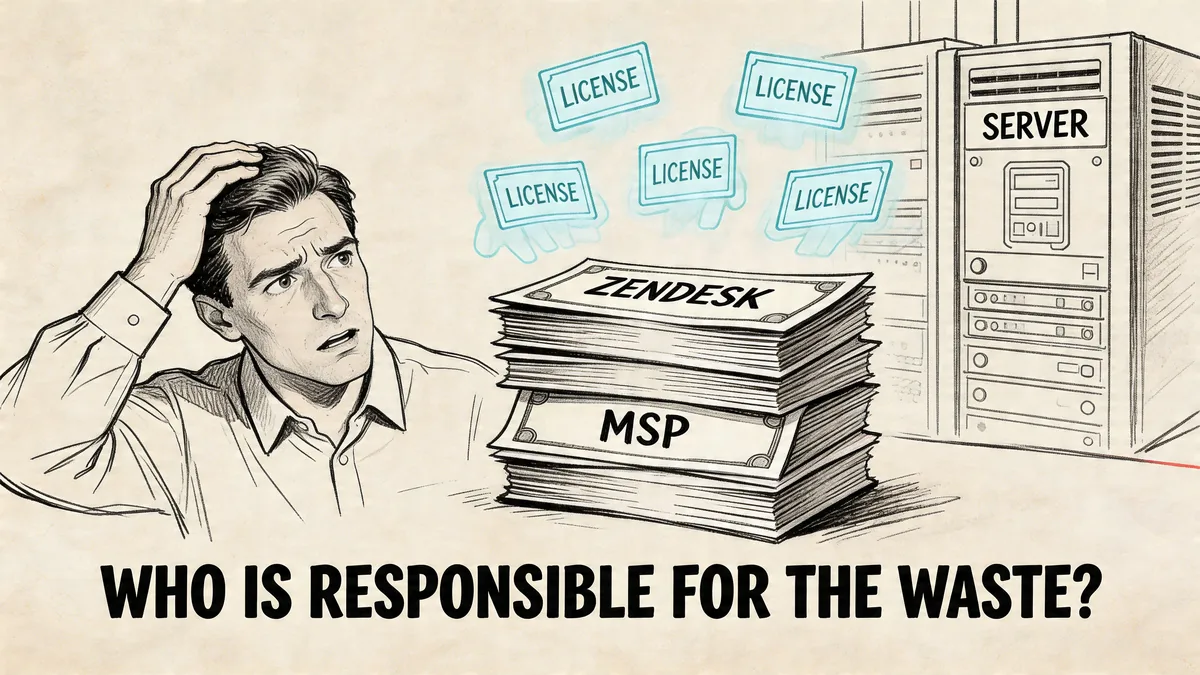
That gap usually comes from one line buried in the agreement, or missing from it entirely. The provider manages access, but not optimization. They provision users, but they aren’t required to review inactivity. They’ll add seats quickly because operations can’t wait. Removing seats is slower because no clause forces anyone to check.
The old contract model misses SaaS waste
The broader market has moved hard toward outsourced service models. The global managed services market is estimated at USD 441.1 billion in 2025 and projected to reach USD 1,314.9 billion by 2035, growing at a 11.5% CAGR, according to Future Market Insights on the managed services market. Contracts need to reflect that shift. They can’t stop at infrastructure and ignore SaaS spend.
Zendesk is where this gets painful fast.
A support team adds seasonal agents. A BPO partner gets temporary access. A manager upgrades a few users to a higher suite for one project. Months later, those changes are still in place. Nobody’s done anything wrong. The contract just never assigned cost governance to anyone.
What it looks like in practice
The pattern is familiar:
- Seats stay active: Offboarded or inactive agents keep paid access.
- Plans drift upward: Users remain on higher Zendesk tiers after the need is gone.
- Reviews never happen: Monthly service reviews focus on incidents, not software waste.
- Finance sees the bill last: By renewal time, you’re arguing from invoices instead of usage data.
Practical rule: If your MSP gets measured on uptime alone, it will optimize uptime alone.
That’s why many teams end up doing SaaS audits manually in spreadsheets. It’s slow, political, and easy to postpone. If you want a better sense of how software waste sneaks into budgets, this breakdown of the cost of SaaS is a useful reality check.
What a Managed Services Contract Should Actually Cover
A good managed services contract is a working blueprint for how your provider will run part of your business. Not just your servers. Your budget discipline too.
If the agreement only describes technical support, it’s incomplete. The useful version ties service delivery to outcomes you care about. Stable systems, predictable invoices, clean user lifecycle management, and reporting you can act on.
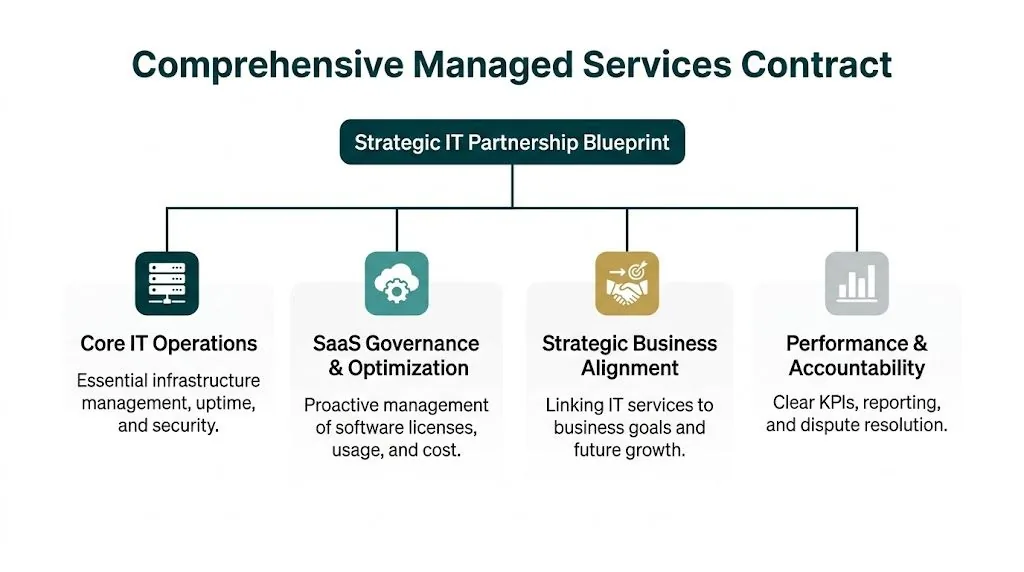
Four pillars matter
I’d review any contract against four pillars.
| Pillar | What it should cover | What goes wrong if it’s missing |
|---|---|---|
| Core IT operations | Infrastructure support, monitoring, patching, backups, security tasks | Systems stay online, but ownership is fuzzy during incidents |
| User support | Help desk, onboarding, offboarding, access changes, escalation paths | Tickets move, but access sprawl grows |
| Performance and accountability | SLAs, service credits, reporting cadence, named contacts, review meetings | You get promises instead of enforceable service levels |
| SaaS governance and optimization | License audits, usage reviews, tier checks, renewal prep, seat cleanup | Your software bill rises without anyone being accountable |
The contract should align incentives
Here’s the practical test. If your provider adds a user to Zendesk today, what happens next?
In a weak contract, nothing. The user gets created, the charge starts, and the seat stays there until someone remembers to revisit it.
In a better contract, the workflow keeps going. There’s an offboarding rule. There’s a scheduled usage review. There’s a report that shows inactive users. There’s a named owner for cleanup. That’s the difference between support and management.
A managed services contract should tell you who does the work, when they do it, how it’s measured, and what happens when they don’t.
What works better than a generic MSA
Generic MSP templates usually bundle everything into broad categories like “application administration” or “user support.” That language sounds fine until billing starts.
For Zendesk-heavy teams, you want the agreement to get specific about:
- Admin tasks: User creation, role changes, deactivation, group changes
- Usage reporting: Monthly review of active vs inactive agents
- Renewal prep: A formal check before Zendesk renewal dates
- Plan governance: Reviews of who needs Suite Team, Growth, Professional, or Enterprise
- Approval rules: Who can authorize new paid seats and under what conditions
Without that detail, the provider can reasonably say license waste sits outside scope. From their perspective, they’re right. From yours, the cost still lands on the budget.
The Non-Negotiable Clauses You Must Include
Start with the clauses that control cost, approvals, and exit rights. Those three areas decide whether your MSP contract protects the budget or gives the provider room to bill around it.
I review this section with operations, finance, procurement, and the person who owns Zendesk administration. That mix matters. Legal will spot liability gaps. Finance will catch pricing ambiguity. The Zendesk owner will see where a vague sentence turns into another paid seat that nobody approved.
Managed Services Contract Clause Checklist
| Clause | What to Look For | Red Flag Example |
|---|---|---|
| Scope of services | Named platforms, covered tasks, exclusions, after-hours rules, project work vs recurring work | “Provider will support business applications as needed” |
| Service levels | Uptime targets, response and resolution targets, severity definitions, service credits | “Commercially reasonable efforts” with no metrics |
| Pricing model | Clear base fee, what triggers extra charges, billing for adds/moves/changes, annual increases | Low monthly fee paired with broad out-of-scope billing |
| Reporting | Monthly service reports, usage reviews, review meetings, named recipients | Reports provided “upon request” |
| Security and access | Access method, least-privilege access, audit logs, admin boundaries, data handling | Full admin rights by default with no audit trail requirements |
| Termination and transition | Exit notice, data return, documentation handoff, admin credential transfer, cooperation period | Termination allowed, but no handoff obligations |
| Liability and remedies | Service credits, caps, carve-outs for negligence or confidentiality, breach responsibilities | Liability cap so low it’s meaningless in practice |
| Change control | Approval process for adding services, tools, users, or premium features | Provider can implement chargeable changes without written approval |
| SaaS governance | License audit cadence, inactivity rules, downgrade review, renewal support, API-based reporting | SaaS named in scope, but no optimization obligations |
Scope is where margin leaks start
Budget problems usually trace back to scope. If the contract says the provider will “administer Zendesk,” that wording is still too loose to protect you.
Spell out the actual work. User provisioning. Deactivation. Role and group changes. Permission cleanup. License reviews. Renewal prep. Reporting. Escalation handling. If a task matters to spend, name it.
Broad MSP language often creates billing disputes because covered services and billable extras are left open to interpretation. Svitla’s guide to managed services agreements notes the importance of defining covered assets, support boundaries, SLA terms, and remedies in specific language rather than broad service labels.
A short scope section with hard edges is better than a long one full of catch-all phrases.
SLA terms need remedies, not good intentions
A provider can answer quickly and still leave you carrying the operational cost.
The SLA should define severity levels, response targets, resolution targets, maintenance windows, and service credits. Credits should apply automatically when the provider misses a committed standard. If the process requires your team to detect the miss, document it, and argue about it on the next invoice, the remedy is weak.
Use measurable language. “Initial response within 15 minutes for Priority 1 incidents” is enforceable. “Best efforts” is not.
What to pin down in the SLA
- Severity definitions: P1, P2, and lower priorities need clear operational triggers.
- Response vs. resolution: Acknowledging the issue is not the same as fixing it.
- Maintenance windows: State when planned disruption is allowed and how notice is given.
- Service credits: Define the amount, trigger, and whether they apply automatically.
- Escalation path: Name who gets involved when the provider misses targets repeatedly.
If the remedy is vague, the SLA is mostly marketing.
Pricing terms shape provider behavior
The fee model tells you what the provider is likely to prioritize.
Flat-fee contracts can work well in steady environments. They also create pressure to keep anything extra out of scope. Per-user pricing matches onboarding and offboarding activity more closely, but it can turn every Zendesk change into a billable event. Hybrid pricing is often the practical middle ground if recurring work and project work are separated clearly.
The contract should answer basic cost questions without interpretation. Are Zendesk seat changes included? Are role changes billable? Is renewal analysis part of the monthly fee? Does the provider get paid to recommend license reductions, or only to add users and configure tools?
For clause wording and comparison points, review a SaaS sample contract with licensing language before the first redline.
Watch these pricing traps
| Model | Good fit when | Common trap |
|---|---|---|
| Flat fee | Stable environment, mature scope, limited change volume | Provider resists work that is not listed line by line |
| Per user or per device | Frequent onboarding and offboarding | License governance is pushed into a separate billable stream |
| Hybrid | You need recurring support plus occasional projects | The boundary between included and extra work stays unclear |
| Consumption-linked billing | Cloud-heavy environment with variable usage | Monthly cost becomes harder to forecast and explain |
Change control protects the budget
This clause gets less attention than pricing, but it does just as much financial work.
Change control should require written approval before the provider adds paid Zendesk seats, upgrades plan tiers, activates premium add-ons, or expands scope. Approval rules should also name who can authorize the spend. If your MSP can take direction from any manager who opens a ticket, you do not have cost control. You have distributed purchasing with delayed visibility.
I push for named approvers, dollar thresholds, and a paper trail. That is especially important for Zendesk because small administrative changes can create recurring charges that stay in place for months.
Reporting has to expose waste, not just ticket volume
Monthly reporting should help you catch spend issues before renewal. Ticket counts and uptime percentages are not enough.
Ask for reports that show open risks, recurring incidents, access exceptions, unresolved offboarding tasks, upcoming renewals, and changes made during the period. For Zendesk, include agent activity, inactive accounts, role mismatches, and paid seats flagged for downgrade review. If the provider cannot produce that report without manual effort every month, they are telling you something about how seriously they treat SaaS cost control.
A useful report creates decisions. It does not just fill a slide deck.
Termination language decides how expensive the exit becomes
Teams usually skim this section while the relationship still looks good. That is when the damage gets baked in.
The contract should require a defined handoff process for admin access, documentation, configuration records, open incidents, and integration details. Set deadlines. Name formats. State who owns the data and how long the provider must cooperate after notice.
For Zendesk, be specific. You want tenant admin transfer, workflow documentation, integration inventories, API-related credentials, and a current user and license roster. If those items are not listed, they are easy to delay, charge for, or omit.
Look for:
- Data ownership: Your data remains yours, with export rights and timing defined.
- Admin handoff: A documented process for returning full control of the Zendesk tenant and related tools.
- Documentation transfer: Runbooks, automations, configurations, integrations, and open issues included.
- Transition assistance: A defined support period after notice, with rates stated in advance if extra help is needed.
A clean exit clause is not about assuming failure. It is about preventing the provider from turning your own system knowledge into an advantage.
The Missing Piece Adding SaaS License Governance to Your Contract
Most MSP agreements mention Microsoft 365, endpoint tools, backup platforms, and security stack administration. They rarely say much about wasted SaaS licenses.
That’s the hole.
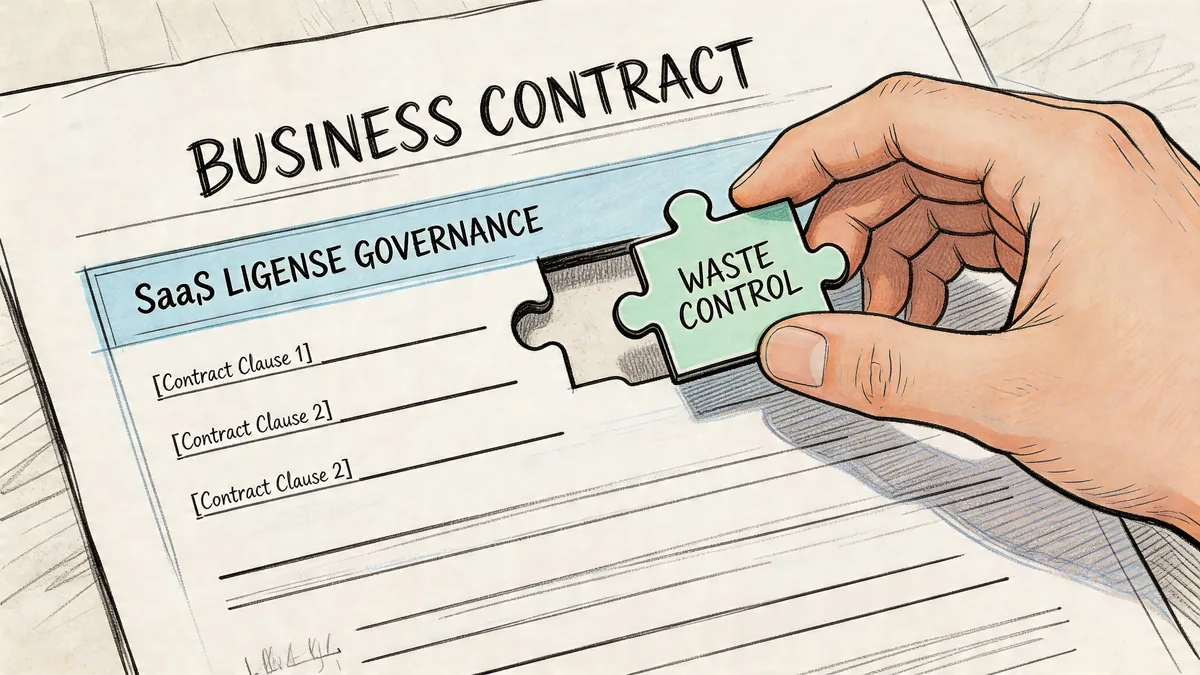
Your Zendesk bill doesn’t usually spike because of one dramatic mistake. It grows because nobody is required to review dormant seats, mismatched plans, or agent access that should have been removed after org changes.
According to Dataprise on evaluating managed services agreements, general MSAs rarely address underused licenses even though organizations waste 20% to 30% of SaaS spend on idle seats, and IDC found that MSAs with embedded SaaS governance reduce mid-term disputes by 35%.
Why generic wording fails
“Manage Zendesk” sounds helpful. It isn’t enough.
A provider can read that phrase narrowly and still meet the contract by handling tickets about login issues, permissions, and user setup. None of that requires them to flag agents who haven’t logged in, users sitting on the wrong plan, or duplicate accounts left over from a migration.
That’s why the contract needs operational language, not just platform names.
What to add for Zendesk
You want a separate SaaS governance clause or addendum. Keep it short. Make it concrete.
Include obligations like these:
- Monthly license audit: Review agent activity, role assignment, and paid seat status.
- Inactivity review: Flag accounts with no meaningful use based on an agreed rule.
- Downgrade review: Identify users on higher Zendesk tiers whose activity doesn’t justify the plan.
- Renewal prep: Deliver a usage-based recommendation before renewal discussions.
- Read-only data access: Permit reporting through API-based monitoring tools.
- Named ownership: State who approves removals and who executes them.
Practical language: “Provider will perform recurring SaaS license governance reviews for Zendesk and deliver written recommendations covering inactive paid users, potential downgrades, and removal candidates.”
A second clause should handle data access:
“Client will provide read-only access, including API-based access where required, for the purpose of usage analysis, reporting, and license optimization. Provider will not make billing or entitlement changes without written client approval.”
That separates visibility from control, which matters to both security and finance.
Make the KPI financial, not just technical
Many contracts measure ticket speed and system uptime. Fine. Add a cost governance KPI too.
Use language tied to process, not fantasy savings guarantees. For example:
| KPI area | Better contract language | Weak contract language |
|---|---|---|
| Audit cadence | Monthly review delivered to named stakeholders | Reviews performed periodically |
| Exception handling | Provider logs inactive-seat findings and tracks disposition | Findings may be discussed as needed |
| Renewal support | Usage summary provided before renewal planning | Provider assists with renewals upon request |
| Access method | Read-only API access permitted for analysis | Access provided at provider discretion |
A short explainer can help internal teams understand what that looks like in practice.
If you’re building your own policy language, these SaaS governance best practices will help you turn the contract clause into an actual operating process.
Negotiation Tips and Red Flags to Spot
Contract review gets easier when you stop arguing clause by clause and start from business outcomes.
Before the first redline, decide what you need the provider to own. Not in theory. In the day-to-day reality of Zendesk admin work, seat cleanup, reporting, and renewal support.
What to do in the negotiation
- Define outcomes first: Tell the MSP you care about budget control, user lifecycle discipline, and renewal readiness, not just help desk coverage.
- Bring examples: Show where inactive agents, stale permissions, or missed removals have created avoidable spend.
- Tie fees to recurring work: If monthly governance is required, get it written into the recurring fee instead of leaving it as ad hoc consulting.
- Name approvers: Decide who can approve new paid seats, premium upgrades, and exceptions.
- Set a review rhythm: Monthly operational reviews work better than vague quarterly catchups when Zendesk staffing changes often.
- Ask for sample reports: If they can’t show what a usage or governance report looks like, they probably don’t have a mature process.
- Keep legal language readable: If your ops lead can’t explain a clause in one pass, it’s too loose.
Red flags worth slowing down for
- Vague application support: “Support for SaaS tools” with no task list underneath it.
- One-way flexibility: The provider can raise scope-based fees quickly, but your exit rights are narrow.
- Auto-renewal buried in legalese: Renewal terms hidden in the back schedules instead of surfaced early.
- No service credits: SLA misses carry no financial consequence.
- Provider-controlled reporting: Reports are optional, delayed, or only available during business reviews they schedule.
- Admin access ambiguity: The contract doesn’t clearly separate your tenant ownership from their operating access.
- Project creep language: Anything outside a narrow support definition becomes billable.
- Renewal support omission: The provider manages the platform all year but has no obligation to help reduce spend before renewal.
The best time to fix contract ambiguity is before onboarding. After that, every debate gets slower and more expensive.
A useful fallback position
If the provider won’t include full SaaS governance in the base agreement, ask for an addendum with a defined monthly review and a renewal-specific obligation.
That’s not perfect. It’s still better than a contract that treats Zendesk like a ticket queue and nothing more.
What to Do Before Your Next Zendesk Renewal
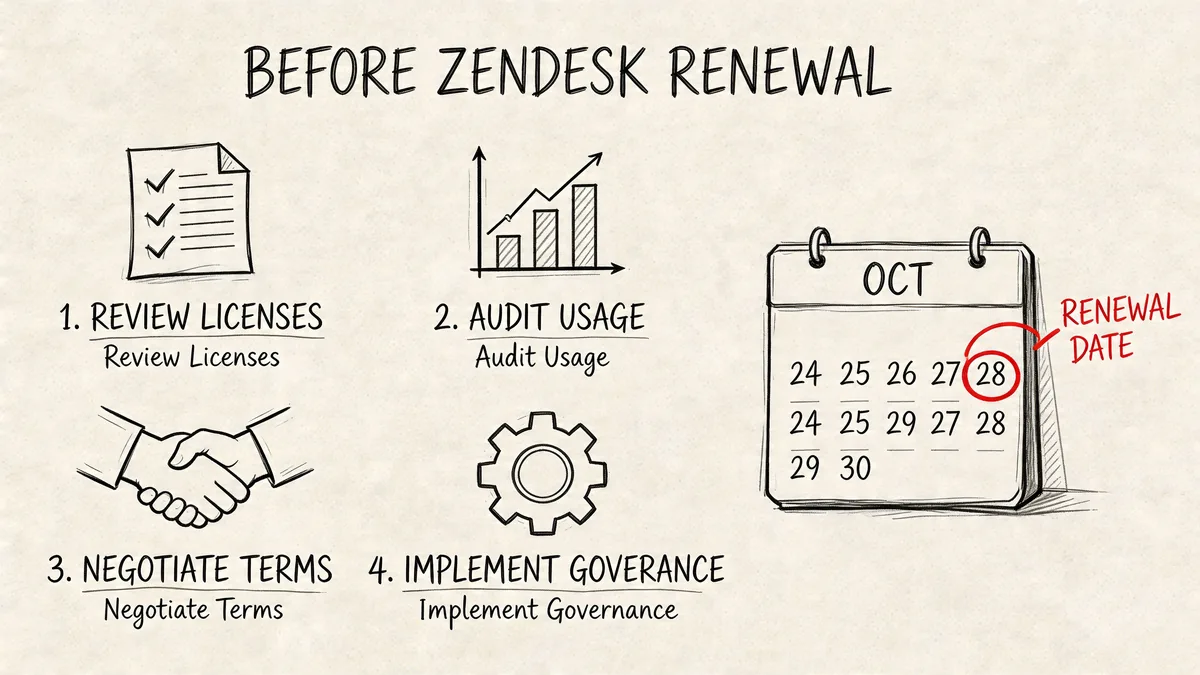
You don’t need to rewrite your entire managed services contract tomorrow. You do need a cleaner plan before renewal season starts.
Start with usage, not opinions
Pull a real picture of agent activity first. Finance will want numbers. Your MSP will want evidence. Your internal admins will want names, not assumptions.
Review who is active, who is inactive, who sits on a higher Zendesk tier than they need, and who still has paid access after role changes.
Compare your current contract against the checklist
Take your existing managed services contract and mark it up.
Look for missing language around:
- Zendesk administration
- License review cadence
- Read-only reporting access
- Renewal support
- Approval rules for paid seat changes
If those aren’t named, assume they are not covered.
Draft a short addendum
You don’t need a giant rewrite. A one-page addendum can close the gap if it covers audit cadence, reporting, data access, ownership, and approval flow.
Keep it operational. Legal can polish the language later.
Build the business case with evidence
A good internal case is usually enough to get movement from procurement and the MSP account team.
Show current waste, explain the process gap, and propose a control that prevents repeat spend. If you need a faster way to quantify inactive Zendesk seats before that conversation, LicenseTrim can connect to Zendesk through OAuth with read-only access and surface where you’re paying for unused licenses.
Frequently Asked Questions About Managed Services Contracts
Should you sign a one-year or three-year term
Start with the pace of change in your environment, not the discount on page one.
A one-year term gives you an exit if the MSP handles tickets well but misses the work that drives spend, such as Zendesk seat cleanup, admin controls, or renewal prep. A three-year term can make sense if pricing is materially better and the provider has already shown they can manage both support operations and SaaS governance.
Longer terms need protection. Build in annual pricing reviews, a written process for updating SaaS license controls, and a termination right tied to repeated service failures or missed governance obligations. Otherwise, you can end up locked into a contract that preserves uptime while license waste keeps growing.
How should AI features be handled in the contract
Treat AI as a billable and risk-bearing scope item, not a vague future capability.
If your MSP plans to use AI for Zendesk triage, summarization, agent assistance, or knowledge suggestions, the contract should state what is included, what requires approval, who configures it, and who is responsible when the setup creates bad routing, poor suggestions, or extra software charges. That matters because AI features often arrive through add-ons, upgraded bundles, or usage-based pricing that finance does not see until renewal.
Put four points in writing:
- Feature scope: Name the AI tools covered by the fee and list exclusions
- Commercial terms: State whether AI features are bundled, usage-based, or passed through at cost
- Approval control: Require written approval before any AI feature that adds Zendesk or third-party license spend is enabled
- Accountability: Assign responsibility for configuration, monitoring, and correction if automations create operational or financial issues
Can one MSP handle everything
One MSP can cover a lot. That does not mean they should own every cost-sensitive workflow.
The question is whether the provider has depth in the areas that affect your budget. Infrastructure support, endpoint management, and security operations are not the same as Zendesk administration, license reviews, and renewal planning. I have seen providers do a solid job on response times while ignoring dormant paid seats for months.
If you keep everything under one MSP, split responsibilities clearly. Name who owns Zendesk user administration, who reviews paid seat changes, who reports on inactive licenses, and who supports renewal analysis. If the provider cannot do that work well, keep SaaS governance with an internal admin or a specialist.
What’s the best way to handle disputes
Write the dispute process so it runs on records, not recollections.
The contract should define what gets reported, how quickly issues must be raised, who attends service reviews, and how unresolved items move from operations to management to legal. Include a requirement to document service failures, unauthorized changes, and billing disputes in writing.
For SaaS spend, add one more rule. Any disputed Zendesk seat increase or add-on charge should be traceable to an approval record. If there is no approval trail, the contract should state who absorbs the cost.
How often should the contract be reviewed
Review the contract on a calendar and on trigger events.
An annual review is the minimum. You should also revisit it before a Zendesk renewal, after a material headcount change, after a support model change, or any time the MSP starts managing a new SaaS tool or introduces paid features.
Contracts drift because operations drift. The agreement should be updated when your licensing model, approval process, or admin ownership changes.
If you want a faster way to prepare for that review, LicenseTrim helps you audit Zendesk license usage with read-only access, identify inactive agents, and quantify wasted spend before you sit down with your MSP or renewal rep.